


Social Farming
Places for living and working together
The Idea: Demographic change meets innovative public services
Society is ageing, and this is also noticeable in the German-Polish border region. The supply situation is deteriorating, particularly in rural areas. There is a shortage of skilled workers in social work, medicine, and nursing. However, the agricultural sector is also struggling with challenges: high land prices, a heavy dependence on subsidies, labour shortages, and the consequences of the climate crisis with increasing extreme weather events and harvest uncertainty.
Social farming seeks new paths: social services and agricultural production are linked in such a way that economic stability, ecological responsibility, and human care go hand in hand. Attractive local jobs and new communities of togetherness are created, while seniors receive the necessary support for a self-determined everyday life. The services relieve family members and strengthen the community.
How do we proceed?
A good life in the countryside does not work through state services alone. It also needs neighbours, good ideas, and mutual support. Regional culture and local knowledge are important treasures and guides for the future. We listen, ask questions, and do not see ourselves as experts with ready-made solutions, but as learners.
Together with you, we want to explore what needs, experiences, and support networks exist locally. How, where, and with whom is farming practiced here? Who looks after the older neighbours? What has changed in living together – and how have you mastered it? We bring together people and organisations who share the same goals and develop ideas together that fit.

Social Farming Workshop Project: Our Vision
We research, test, and promote a new economic and living model: agriculture and social services grow together, supported by regional businesses, committed citizens, and experts. This secures care and togetherness in old age, strengthens the economy, and protects the environment.
Caring for older people is a common goal of state welfare, civil society organisations, and private commitment. When neighbourhoods, families, professionals, businesses, and institutions work together, sustainable solutions emerge. This makes the countryside fit for the future – with a good quality of life for all generations.
PFS Heinersdorf – Green-White Cooperation in Oderland-Spree
Based on the Third Round Table on ‘Social Farming’ and many years of research into needs in Berlin-Brandenburg, the cooperation between the Heinersdorf Practice Research Centre, the Catholic University of Applied Sciences Berlin, and BTU Cottbus-Senftenberg developed. Here you can find the homepage of the Green-White Cooperation project in Oderland-Spree.
Goal of the workshop project:
- How can spaces for fulfilled ageing in rural areas be specifically designed?
- Under what conditions do attractive working contexts for carers and support staff arise?
- What impulses do innovative care communities provide for local communities and cultural landscapes?
- What added value and business models result for agricultural businesses?
Our project plan: Models for more eco-social quality of life in the countryside
Initial contact and networking
The journey begins with diverse access opportunities: interested parties first come into contact with the project through contacts in the region and the social environment, through conferences and workshops, and through networking and the matching of businesses or providers. Storytelling cafés are of particular importance, in which seniors, as experts in their region, trace the connecting lines between the landscape and local culture.
Joint workshops and process support
The interaction of those involved results in ‘workshops on eco-social quality of life in the countryside’. Central to this is comprehensive process support, which includes help with the development of concepts, financing plans, networking, and the transfer of existing knowledge and contacts. The project’s research associates accompany this process.
From the workshop to social-spatial change
The workshops are the starting point for concrete transformation: here, taking regional-specific needs into account, the citizens of a place are brought together with local agriculture, social services, and other actors in the social and natural environment. At least two of these workshop processes are intended to lead to implemented model projects in the transfer area – places that show how biodiversity-sensitive cultural landscapes, resource-conserving public services, and new forms of participation for older people can interlink.

Latest news from Social Farming
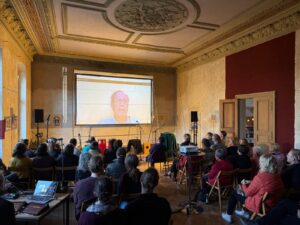
- On 22 September, the Heinersdorf Manor House hosted the Sparking Pluriverse, an evening dedicated to ageing in rural areas and Social Farming.

- What happens when agriculture meets social work? And what does the everyday life of those who build this bridge look like? To provide an insight into their consultancy practice, the Green-White Cooperation team interviewed themselves.
Contact
Social Farming Workshop Project
Email: SoziaLaWi@alterperimentale.de
Prof. Dr Alexandra Retkowski
Project Management
Prof. Dr Ludger Gailing
Project Management
Oscar Corman
Research Associate
Tel: +49 (0) 17 5891 5205
Susanne Lerche
Research Associate
Tel: +49 (0) 17 5753 9592
Sunna Kovanen
Research Associate
Tel: +49 (0) 355 69 3556
Brandenburg University of Technology
Cottbus-Senftenberg
Lipezker Strasse 47
03048 Cottbus